The Widening Racial Scoring Gap on the SAT College Admissions Test
The Widening Racial Scoring Gap on the SAT College Admissions Test
The racial scoring gap on the SAT test has now become wider than has been the case for the past two decades. Many believe that in the years to come the gap may grow smaller, not because blacks are catching up to whites in educational achievement, but rather because the test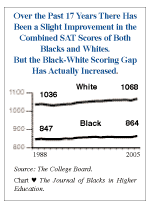 makers are adding a writing component to the test that may be manipulated to lessen racial differences and therefore reduce public criticisms of the test.
 For many decades The College Board has used a 200 to 800 scoring scale of performance for both the verbal and mathematical sections of the Scholastic Assessment Test. Now a writing component has been added to the SAT. From now on, students will receive three scores each ranging between 200 and 800. In the past a 1600 has been the best possible score on the composite SAT. Hereafter, the best composite score will be 2400. This means that this year's test results will be the last time JBHE will be able to compare black-white SAT scores based on the scoring system that has been used since racial differences in test results were first made public in 1976.
SnipIf you don't like the outcome then change the game.
Here is the history.
In 1976 The College Board published an analysis of the racial differences in scores of the Scholastic Assessment Test (SAT). At that time the average black score was about 240 points, or 20 percent, below the average white score. When The College Board next examined the racial scoring gap in the early 1980s, the gap had shrunk to 200 points. Black scores were then 17 percent lower than white scores.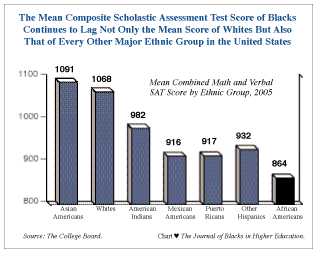 By 1988 the black-white SAT test scoring gap was down to 189 points. The trend was distinctly encouraging. Many specialists in the educational community predicted that in time the racial scoring gap would disappear altogether.
Of course, Negroes being Negroes, the gap didn't disappear as hoped.
In 2005 the average black score on the combined math and verbal portions of the SAT test was 864. The mean white score on the combined math and verbal SAT was 1068, 17 percent higher.
Explaining the Black-White SAT Gap
There are a number of reasons that are being advanced to explain the continuing and growing black-white SAT scoring gap. Sharp differences in family incomes are a major factor. Always there has been a direct correlation between family income and SAT scores. For both blacks and whites, as income goes up, so do test scores. In 2005, 28 percent of all black SAT test takers were from families with annual incomes below $20,000. Only 5 percent of white test takers were from families with incomes below $20,000. At the other extreme, 7 percent of all black test takers were from families with incomes of more than $100,000. The comparable figure for white test takers is 27 percent. 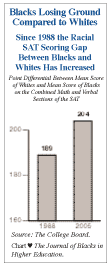
But there is a major flaw in the thesis that income differences explain the racial gap. Consider these three observable facts from The College Board's 2005 data on the SAT:
• Whites from families with incomes of less than $10,000 had a mean SAT score of 993. This is 129 points higher than the national mean for all blacks.
• Whites from families with incomes below $10,000 had a mean SAT test score that was 61 points higher than blacks whose families had incomes of between $80,000 and $100,000.
• Blacks from families with incomes of more than $100,000 had a mean SAT score that was 85 points below the mean score for whites from all income levels, 139 points below the mean score of whites from families at the same income level, and 10 points below the average score of white students from families whose income was less than $10,000.

No comments:
Post a Comment